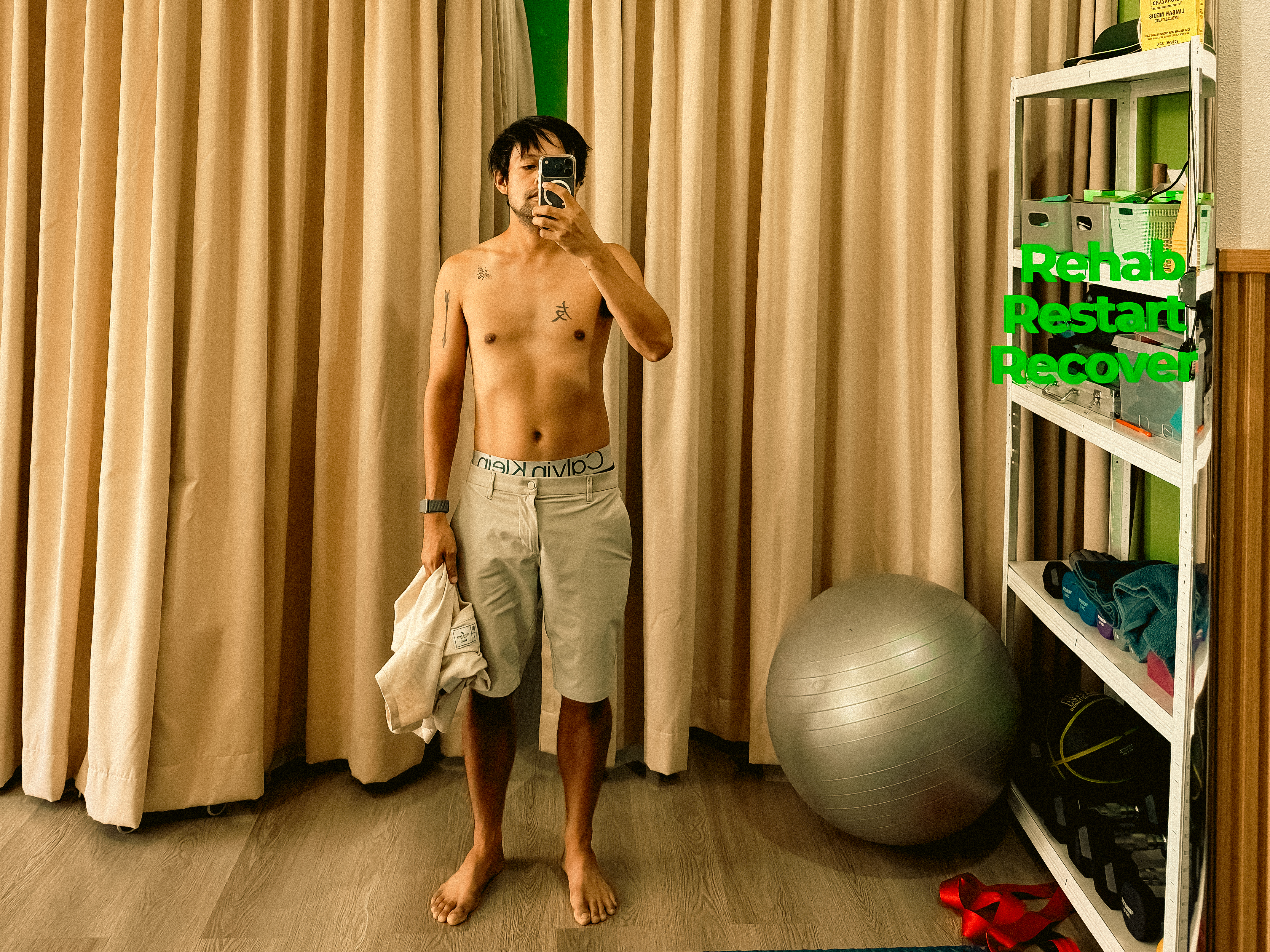
Injuries, compounding damage, and the things we carry in our lower backs.
The Snap

I heard it before I felt it.
A single pop, internal and sharp, the kind of sound that does not belong inside a living body. One moment I was mid-air, launching into a skater jump at the corner of the badminton court. The next, I was on the floor, both hands and knees against the cold concrete, trying to remember how breathing worked. The pain was not the gradual, creeping kind you can negotiate with. It arrived all at once, immediate and total, the way a door sounds when it is kicked in.
The painful area was familiar. But this time, something in me went quiet along with it. This time, it scared me.
Wednesday nights are for weekly badminton. I had arrived early that night, a little too excited to play. My Whoop said 89% recovery. I had just woken from a good nap. I felt untouchable, the specific kind of untouchable that always ends exactly one way.
I decided I needed more warm-up because I was primed and ready. Lateral bounds and single-leg drops with long forward jumps. Three reps after half-court jumps, I stood on my right foot and pushed off to the left.
And then the floor.
No badminton for me that night. Just enough breath to go home.
The Following Day

Thursday is our weekly Ultimate Frisbee pickup. I had to pull my name from the list last minute. “So not cool,” a mate said. I know. I know. But I could barely walk.
Moving from the bed to the bathroom felt like two full days of tournament. Every step was a sharp, humbling reminder of the field I was not on.
But the physical pain was not the worst part. The worst part was the worry: what if I cannot play anymore? Frisbee is not just the sport I love. It is the reason I live in Bali. The entire architecture of my life here, the schedule, the friendships, the reason to wake up early and sleep tired, is built around it.
To make it worse: this was not the first time. A week earlier, I had hurt my back during a deadlift. No pop, just a gradual dull soreness I told myself was a severe muscle strain, just like post-gym sore but worse, you know? Two days later I was back sprinting on the field, playing three pickups in a row before getting re-injured nine days after as a consequence. Although the first time I was back on the field by day two, this time, on day three, I am still walking like a water monitor.
The next morning, my neighbor friend who was with me at badminton found me in the kitchen, assembling breakfast one careful inch at a time.
“How are you, Jhay?”
“A little bit better than last night. There’s hope.”
“What do you mean ‘hope’? You’re not dying, Jhay.” He said it half-laughing.
I half-smiled and thought: but I’m also not living [right now].
What the Physio Said
I went to see a local physiotherapist the following day. Her English was broken but what she was saying was wholesome. She tried her best to explain what was going on inside my body, why it happened, and patiently answered every childish question I threw at her without making me feel like an idiot for not knowing.
The good news: no permanent damage. No nerves. No disc. Nothing catastrophic. Yet. (Take note on that “no disc” part. We will come back to it.)
The not-so-good news: four weeks of rehab. No sprinting. No [Frisbee] disc. Just stretching, light walking, and drowning from drinking so much water.
Four weeks? For someone who cannot wait three days between pickups, that might as well be a life sentence.
Going back too soon without proper rehab significantly increases the chance of re-injury, she said. Which is exactly what happened the first time. My back had not fully recovered. I put load on it anyway. It gave out. The science is not complicated.
I walked out of that clinic carrying two things: relief that there was a path forward, and a quiet fear I had not admitted out loud yet. What if it snaps mid-game? While I am sprinting full speed? While I am in the air chasing a disc with everything I have? That jolt of pain at the badminton court was almost unbearable under controlled conditions. In an actual game, it would end me on the spot.
I chose to commit to the rehab (as if I had a choice). I cleared my calendar. No pickups. No sprint training. Nothing but slow walks and the kind of stretching that makes you feel ninety years old.
The Back Story of the Back Injury

It has been a while since I wrote a personal blog. A lot has changed. Everything has, really. And here I am, returning to writing not because of a career milestone or a big trip, but because my back gave out at a badminton court on a Wednesday night and I needed somewhere to put all this frustration, and to remember this account before the details go soft. Of course, I have no video of it. I am not an influencer who stops mid-accident to record.
Funny how a few years ago, a productive day looked like lobbying national policies to lawmakers, leading international teams in US or Europe, conceptualizing UN-recognized projects, and institutionalizing nationally award-winning programs. Now it looks like eating enough protein, feeding a stray dog outside a warung, watching the sun set into the rice fields, and looking forward to the next pickup game. Different metrics. Same guy, I think.

And mostly just lying in bed now unable to do the one thing that I enjoy doing, I had a lot of time to think about why this really happened. Not just the skater jump that set it off, but everything before it.
I was brought to a time when I spent more than ten years sitting in an office, 8 AM to 5 PM, six days a week, frequently longer. And before that, my college years were spent hunched over a keyboard overnight, coding with the intensity of someone who thought having carpal tunnel was cool. I did not stretch. I did not know what mobility work was. My movement breaks were limited to bathroom visits and occasional instant noodles run.
The snap at that badminton court might have been triggered by the skater jump, on top of a deadlift injury that never fully healed. But it was caused by a decade of accumulated stillness, years of loading a weakened structure and quietly calling it “just aging.” The injury simply found the weakest point in the building and walked right through it.
The Power of Compounding
I believe in compounding. Not just the financial kind, but the kind that applies to everything quietly and without warning: habits, choices, rest, and neglect. Whatever you do or do not do today will show up somewhere down the line, in a form you may not recognize at first.
My lower back had been sending signals for years. Whenever I went to the gym, I just kept training my legs and chest, and then one day casually lifted a 100-kg deadlift from my usual 60. No thought for what was already fraying underneath.
This is the price of a decade of compounded shortcuts.
There is something almost darkly funny about the timing. The week before all this, I posted on Instagram about slowing down, about not flying to play tournament after tournament without letting the body catch up. I wrote it like someone who had already figured something out.
I’d like to see it this way though: At least this happened in my 30s, not my 50s. My body still has the capacity to recover (somehow, with physio visits and prayers), to rebuild, to be strengthened deliberately instead of just pushed until something gives. I know now which part of me needs the most attention. I know now that playing at a high level for years to come requires more than just showing up and running hard on borrowed time.
I always wondered why rehab is a recurring chapter in every athlete’s story. They always say it is just a matter of time before it finds you. I used to watch those Instagram stories from the comfort of a fully functional back.
Now I get it.
Turns out the body keeps score.
And at some point, it just decides for you: game over. Off season. #

Leave a Reply